

Introduction
If you’re in the plastic, construction, piping, packaging, or manufacturing business, you already know one thing: PVC resin prices can change your profit overnight. One day you’re quoting comfortably, and the next day the market jumps and your margins shrink.
That’s why tracking Reliance PVC Resin Price Today isn’t just “nice to know”—it’s a daily survival tool for traders, processors, wholesalers, and industrial buyers.
In this in-depth guide, we’ll break down what affects Reliance PVC Resin Price Today, how you can understand pricing movement like a pro, and how businesses can make smarter purchasing decisions. Along the way, we’ll also simplify the logic behind price movement using a surprising but useful concept: the reactivity series of metals—a framework that helps explain why some factors influence prices faster and stronger than others.
Here’s the most current pricing information available right now for PVC resin that you can use to extend your post — based on recent industry data (as of early February 2026). Please note that exact Reliance PVC Resin Price Today official list from Reliance itself isn’t publicly posted every day, but latest market assessments give a good real-time estimate:
📌 Current PVC Resin Price (Market Benchmarks)
Estimated domestic India PVC resin price trend:
- Indian PVC resin prices are currently assessed around USD 700–750 per metric tonne CFR (Cost & Freight) levels, which translates roughly to ₹58,000–₹62,000 per metric tonne (depending on grade and port) as of latest assessments in early February 2026. This reflects a week-on-week increase from previous levels. (Polymerupdate)
Reliance pricing movement:
- A domestic industry source reported that Reliance Industries Ltd raised PVC resin suspension grade prices by about ₹1.50/kg (₹1,500/MT) effective 11 Feb 2026 to align with market conditions. (Polymerupdate)
📌 Approximate Converted Price Range (Reliance PVC Resin Price Today)
| Metric | Estimated Price |
|---|---|
| CIF South Asia PVC Resin (current market) | USD 700–750/MT (~₹58,000–₹62,000/MT) (Polymerupdate) |
| Recent domestic Reliance price revision | +₹1,500/MT (price hike effective 11 Feb 2026) (Polymerupdate) |
🔹 Note: Actual ex-works price from Reliance India for specific grades (pipe/film/injection) may vary above or below this range depending on grade, quantity, location (ex-works vs delivered), freight, and negotiation terms. These figures are representative market indicators rather than official ex-works lists.
“As of early February 2026, Reliance PVC Resin Price Today is roughly estimated around ₹58,000 to ₹62,000 per metric tonne for mainstream suspension grades, with Reliance recently increasing prices by about ₹1,500/tonne to reflect market trends. This aligns with global PVC resin prices trading near USD 700–750/tonne CFR South Asia, showing a firming trend in polymer markets.” (Polymerupdate
Understanding Reliance PVC Resin Price Today (And Why It Matters)
Tracking the Reliance PVC Resin Price Today is essential because PVC resin is one of the most widely used raw materials in India. It impacts:
- Pipe and fittings manufacturing
- Cable and wire insulation
- Flooring and wall panels
- Medical packaging
- Furniture and profiles
- Films and sheets
When the Reliance PVC Resin Price Today rises, product costs increase. When it falls, buyers can stock up and improve margins.
Now here’s the interesting part: the market behaves like the reactivity series of metals. Some influences react immediately (like crude oil), while others react slowly (like seasonal demand).
That’s why using the reactivity series of metals as a mental model can make you better at predicting PVC trends.
What Is PVC Resin and Why Reliance Matters So Much?
PVC stands for Polyvinyl Chloride. PVC resin is the raw powder used to manufacture PVC products.
Reliance is one of the biggest industrial names in India, and its pricing is considered a benchmark.
So when people ask:
“What is Reliance PVC Resin Price Today?”
They are really asking:
- What is the current market direction?
- Should I buy now or wait?
- Will prices go up next week?
And yes, the reactivity series of metals concept fits perfectly here because pricing forces don’t hit equally—some are “highly reactive” and move the market quickly.
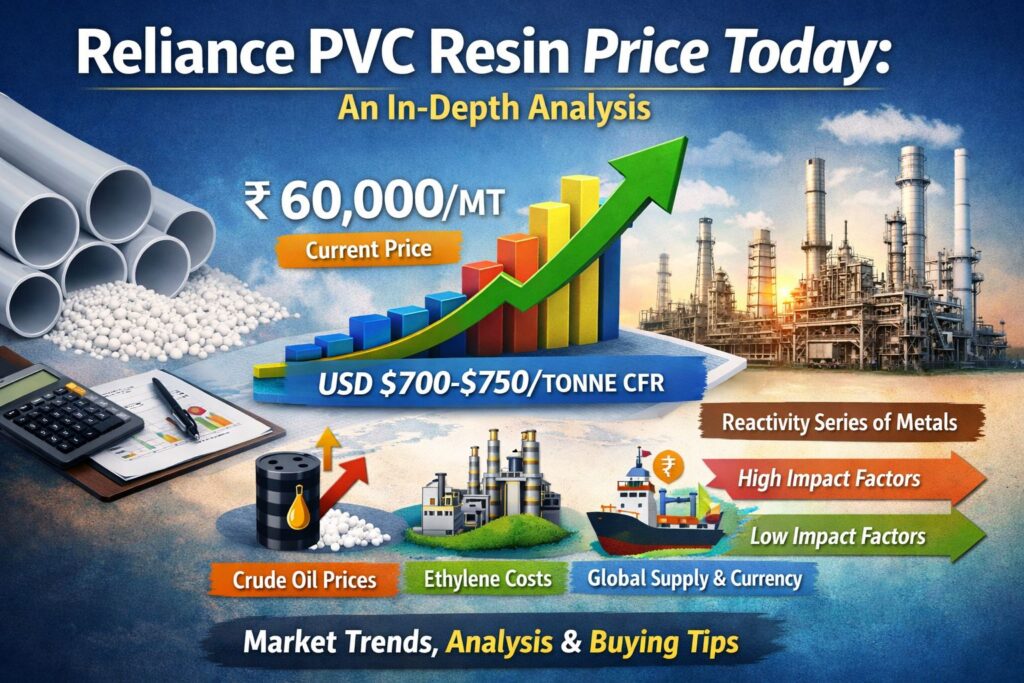
Reliance PVC Resin Price Today: Key Factors That Move Prices Fast
To understand Reliance PVC Resin Price Today, you need to know the main drivers.
Think of these drivers like the reactivity series of metals:
Highly Reactive Factors (Fast Movers)
These are like the top of the reactivity series of metals—they react quickly and strongly:
- Crude oil price changes
- Ethylene price shifts
- Global PVC supply disruptions
- Currency fluctuations (USD-INR)
- Import restrictions or sudden duties
Moderately Reactive Factors
These behave like mid-level in the reactivity series of metals:
- Domestic demand changes
- Construction industry trends
- Government infrastructure spending
- Seasonal market behavior
Low Reactive Factors (Slow Movers)
These are like the bottom of the reactivity series of metals:
- Long-term capacity expansions
- Policy reforms
- Slow industrial changes
- Permanent demand shift due to new materials
This “reactivity series of metals” style thinking helps you quickly decide what’s urgent and what’s background noise.
How Reliance PVC Resin Price Today Is Decided
Reliance typically releases pricing based on a mix of:
- Domestic demand
- International PVC pricing
- Import competition
- Feedstock costs (like ethylene)
- Inventory levels
So when Reliance PVC Resin Price Today changes, it’s rarely random.
And again, the reactivity series of metals helps explain it: some cost pressures are immediate, others build slowly.
Reliance PVC Resin Price Today vs Imported PVC: Which One Wins?
Many buyers compare Reliance PVC Resin Price Today with imported PVC resin from:
- China
- Taiwan
- South Korea
- Japan
- Middle East
Comparison Table
| Factor | Reliance PVC Resin | Imported PVC Resin |
|---|---|---|
| Availability | Strong in India | Depends on shipping |
| Delivery Time | Faster | Slower |
| Price Volatility | Moderate | High |
| Quality Consistency | High | Varies by origin |
| Currency Risk | Low | High (USD-based) |
If imports become cheaper, Reliance PVC Resin Price Today may soften.
This is exactly like the reactivity series of metals—imports can “react” aggressively and displace local pricing.
How Crude Oil Impacts Reliance PVC Resin Price Today
PVC is not directly crude oil, but crude affects:
- Energy costs
- Transportation
- Petrochemical feedstock chain
When crude rises, the whole chain becomes expensive.
Crude oil is a top-level driver, like the most reactive element in the reactivity series of metals.
So when crude rises sharply, Reliance PVC Resin Price Today often follows within days or weeks.
The Role of Ethylene and Chlorine in PVC Pricing
PVC is made from:
- Ethylene (from petroleum/natural gas)
- Chlorine (from salt via electrolysis)
Why This Matters
If ethylene prices increase:
- Production cost rises
- PVC becomes expensive
- Reliance PVC Resin Price Today can rise
Ethylene is again high in the reactivity series of metals analogy—fast reaction, fast impact.
Demand-Side Factors Affecting Reliance PVC Resin Price Today
Demand is not constant. It changes due to:
- Real estate construction
- Water pipeline projects
- Agriculture irrigation demand
- Government housing schemes
- Industrial production cycles
High Demand Months in India
- February to June
- August to November
Low Demand Months
- Peak monsoon in some regions
- Slowdowns during uncertainty
Demand works like a medium-reactive force in the reactivity series of metals: it influences strongly, but not instantly.
Seasonal Trends in Reliance PVC Resin Price Today
PVC resin demand is closely tied to:
- Construction cycles
- Agricultural irrigation
- Infrastructure projects
That’s why Reliance PVC Resin Price Today can show seasonal patterns.
And yes—seasonal demand behaves like a mid-level position in the reactivity series of metals.
It reacts, but not as explosively as crude oil.
Supply Chain and Logistics: The Hidden Driver
Sometimes the resin is available, but delivery is not.
Price can rise due to:
- Transport strikes
- Container shortages
- Port congestion
- Truck freight hikes
Logistics is a “high reactivity” factor in the reactivity series of metals model because it can impact availability quickly.
When resin supply tightens, Reliance PVC Resin Price Today may rise.
Reliance PVC Resin Price Today: Types and Grades
Reliance supplies multiple PVC resin grades, commonly used for:
1) Pipe Grade PVC Resin
Used for:
- UPVC pipes
- CPVC compounding
- Fittings
2) Suspension PVC Resin
Used for:
- Profiles
- Sheets
- Films
3) Emulsion PVC Resin
Used for:
- Coatings
- Synthetic leather
- Specialty applications
Each grade can have different pricing, and that’s why Reliance PVC Resin Price Today is not always one single number.
This is similar to the reactivity series of metals: not all metals behave the same, and not all PVC grades react the same.
How Traders Use Reliance PVC Resin Price Today to Make Profit
Traders don’t just “buy and sell.” They watch price behavior.
Common trader strategies
- Stock before expected hikes
- Sell fast during high demand
- Use imports as leverage
- Hold inventory during rising trend
This is where the reactivity series of metals mindset becomes powerful:
- Highly reactive signals = act fast
- Low reactive signals = plan long-term
Reliance PVC Resin Price Today: Real-World Buying Tips
If you are a manufacturer or buyer, here are smart tactics.
Best Buying Practices
- Track prices weekly, not monthly
- Compare Reliance vs import landed cost
- Buy extra when demand is low
- Avoid panic buying during sudden spikes
- Keep minimum safety stock
Quick Checklist
- Is crude rising? (High in reactivity series of metals)
- Is USD rising? (High in reactivity series of metals)
- Is demand peaking? (Mid in reactivity series of metals)
- Is supply tight? (High in reactivity series of metals)
Pros and Cons of Reliance PVC Resin (Business Perspective)
Benefits
- Reliable supply
- Strong quality
- Trusted domestic brand
- Less currency risk
- Faster delivery
Drawbacks
- Can be costlier than imports at times
- Price may rise during demand peaks
- Limited bargaining power for small buyers
Again, imports behave like a highly reactive competitor in the reactivity series of metals, forcing price competition.
How Small Manufacturers Can Manage Reliance PVC Resin Price Today
Small units struggle the most because they buy in small quantities.
Practical Solutions
- Form buyer groups
- Negotiate with distributors
- Keep track of price patterns
- Avoid buying at peak demand
- Explore credit-based procurement
Small manufacturers should treat price triggers like the reactivity series of metals: focus on fast-reacting factors first.
Reliance PVC Resin Price Today: How to Track It Daily
Here are the most common ways buyers track prices:
Reliable Sources
- Official distributor price circulars
- Dealer networks
- Market WhatsApp groups
- Industry portals
- Import pricing comparisons
Best Practice
Maintain a simple spreadsheet:
| Date | Reliance PVC Resin Price Today | USD-INR | Crude Trend | Notes |
|---|---|---|---|---|
| Example | ₹XX/kg | 83.2 | Rising | Demand high |
Tracking this way helps you understand the reactivity series of metals behavior in pricing.
How Currency (USD-INR) Impacts Reliance PVC Resin Price Today
Even domestic PVC pricing is influenced by the dollar because:
- Imports become expensive
- Global PVC is dollar-linked
- Feedstock contracts are often USD-based
If USD rises:
- Imports become costlier
- Reliance can raise pricing
- Reliance PVC Resin Price Today can move upward
Currency is extremely reactive—very high in the reactivity series of metals model.
Reliance PVC Resin Price Today During Market Crash vs Boom
PVC behaves differently during:
Market Boom
- Demand increases
- Prices rise
- Supply tightens
- Buyers panic stock
Market Crash
- Demand drops
- Prices soften
- Inventory builds
- Buyers delay purchases
Boom/crash cycles are similar to the reactivity series of metals: when a highly reactive event happens, the market reacts fast.
Use Cases: Industries Most Dependent on Reliance PVC Resin Price Today
1) Pipe and Fittings Industry
- Biggest PVC consumer
- Sensitive to price fluctuations
2) Wire and Cable Industry
- Uses PVC for insulation
- Stable demand but cost-sensitive
3) Packaging Industry
- Uses PVC sheets/films
- Competes with PET and PP
4) Construction and Interiors
- PVC panels, flooring, profiles
- Demand tied to real estate
All these industries behave like different “metals” in the reactivity series of metals—some react quickly, others slowly.
Reliance PVC Resin Price Today vs Other Indian Brands
Reliance competes with:
- Finolex
- DCW
- Chemplast
- Other domestic suppliers
Why Reliance Pricing Matters More
- Market leadership
- Strong distribution
- Large volume supply
- Benchmark role
So even competitors indirectly follow Reliance PVC Resin Price Today.
This dominance is similar to how top elements in the reactivity series of metals dominate chemical reactions.
How to Predict Reliance PVC Resin Price Today (Simple Model)
You don’t need a PhD. You need a system.
Step-by-step prediction method
- Check crude oil trend
- Check USD-INR
- Check import offers
- Check demand season
- Check local inventory levels
If 3 out of 5 signals point upward, prices likely rise.
This is basically applying the reactivity series of metals concept to business: the strongest signals dominate the reaction.
Common Mistakes Buyers Make
Many buyers lose money not because prices change, but because they react wrongly.
Top mistakes
- Buying too late in a rising market
- Buying too early in a falling market
- Ignoring imports
- Not tracking currency
- Stocking too much during slow demand
The reactivity series of metals lesson: don’t treat all signals equally.
Best Strategy for Long-Term Purchasing
Long-term buyers should focus on:
- Average yearly pricing
- Demand cycles
- Reliable suppliers
- Inventory planning
Smart long-term approach
- Buy in small batches during uncertain periods
- Stock in low-demand months
- Avoid heavy buying in peak months
- Build relationships with dealers
Long-term planning is like low-reactivity elements in the reactivity series of metals: stable, slow, but powerful.
FAQs Section
| Question | Answer |
|---|---|
| What is Reliance PVC Resin Price Today? | It refers to the current market rate of PVC resin supplied by Reliance, used as a benchmark across India. |
| Why does Reliance PVC Resin Price Today change frequently? | Because PVC prices depend on crude oil, ethylene, demand, imports, currency, and supply availability. |
| Is Reliance PVC resin better than imported resin? | Often yes for consistency and delivery speed, but imports may be cheaper depending on USD and global supply. |
| How does USD-INR affect Reliance PVC Resin Price Today? | A stronger dollar increases import costs, which can push domestic prices upward. |
| Which industry is most affected by Reliance PVC Resin Price Today? | The pipe and fittings industry is the most sensitive due to high volume consumption. |
| How can I track Reliance PVC Resin Price Today daily? | Through distributors, dealers, pricing circulars, and industry market updates. |
| Does crude oil directly decide PVC resin price? | Not directly, but it heavily influences feedstock and production costs, making it a major driver. |
| Can Reliance PVC Resin Price Today fall suddenly? | Yes, especially when demand drops, imports become cheaper, or global PVC supply increases. |
| What is the best time to buy PVC resin? | Usually during low-demand months or when crude and USD are stable. |
| How does the reactivity series of metals relate to PVC pricing? | It works as an analogy: some factors (crude, USD) react fast and strongly, while others (seasonal demand) react slowly. |
Conclusion
Understanding Reliance PVC Resin Price Today is one of the smartest moves any PVC buyer, trader, or manufacturer can make. Prices are influenced by multiple forces—crude oil, ethylene, imports, currency, demand, and supply conditions.
The best way to think about these factors is like the reactivity series of metals: some forces react instantly and move the market quickly, while others are slow and steady.
Final Takeaway
If you want to buy smarter, avoid losses, and increase profit margins, start tracking Reliance PVC Resin Price Today consistently—and always watch the most “reactive” signals first.
If you want, I can also create:
- A weekly tracking sheet format (ready for Excel)
- A price prediction checklist
- A buyer’s guide for PVC resin purchasing in India


Pingback: CGPC PVC Resin: The Comprehesive Guide - Safe Climber Overseas Pvt. Ltd.
Pingback: Reliance PVC Resin - The Authentic Power of a Surprising Solution - Safe Climber Overseas Pvt. Ltd.